The oligonucleotide therapeutics field is entering a new phase of clinical and commercial maturity, driven by increasing approvals, expanding pharma investment, and growing complexity across ASOs, siRNA, gRNA and conjugates. However, as momentum builds, oligonucleotide analytical development and CMC are emerging as the primary limiting factors impacting timelines, regulatory success, and scalability.
This page explores the six biggest oligonucleotide CMC and analytical development challenges impacting drug developers today, spanning impurity profiling, regulatory uncertainty, analytical complexity, manufacturing scale-up, comparability, and cross-functional alignment. Each bottleneck is mapped to practical, solution-focused sessions at the 5th Oligonucleotide Analytical Development & CMC Summit.
1. Impurity Profiling Challenges in Oligonucleotide Development
Impurity profiling remains one of the most significant bottlenecks in oligonucleotide analytical development. Due to increasing chemical complexity, oligonucleotides generate large numbers of closely related impurities, including truncated sequences, mismatches, and modified linkages. As modalities evolve into conjugates and highly modified chemistries, impurity profiles are becoming more complex and less predictable.
Regulatory expectations for impurity characterisation in oligonucleotide CMC are increasing, with agencies expecting a deep understanding of impurity origin, structure, and impact. However, global guidance remains unclear, leaving teams uncertain about what constitutes acceptable impurity control strategies. In practice, this can delay IND submissions, create approval risk, and complicate scale-up.
Sessions Addressing This Bottleneck:
2. Regulatory Uncertainty in Oligonucleotide CMC
Regulatory challenges in oligonucleotide CMC continue to create uncertainty across global development programmes. While the EMA has released draft guidance, the FDA and other regions still lack clear oligonucleotide-specific frameworks, leading to inconsistent expectations across markets.
Regulators are increasing expectations around impurity control, analytical validation, and comparability, but without clearly defining what sufficient data looks like. This leaves drug developers navigating high-risk submissions, often over-engineering data packages or facing costly delays.
Sessions Addressing This Bottleneck:
3. Analytical Complexity in Oligonucleotide Development
Analytical complexity is increasing as oligonucleotide therapeutics expand into conjugates and highly modified chemistries. Traditional analytical tools are often insufficient to fully characterize heterogeneous structures, requiring advanced, orthogonal analytical strategies.
This creates challenges in defining critical quality attributes (CQAs), ensuring reproducibility, and supporting regulatory submissions. The need for more robust analytical development strategies is now critical across the entire lifecycle.
Sessions Addressing This Bottleneck:
4. Manufacturing Scale-Up Challenges in Oligonucleotide Production
Oligonucleotide manufacturing scale-up is now one of the most critical bottlenecks as therapies move toward commercialization. Transitioning from laboratory to GMP-scale production requires reproducibility, cost control, and robust process design.
New synthesis methods, including liquid-phase and enzymatic approaches, offer opportunities but also introduce new variability, impurity risks, and analytical challenges. Companies must balance innovation with regulatory compliance.
Sessions Addressing This Bottleneck:
5. Comparability & Process Change Risk in Oligonucleotide CMC
Comparability remains a major hurdle in oligonucleotide CMC, particularly when making process changes such as switching synthesis methods or scaling up manufacturing. Demonstrating equivalence across batches and processes is technically complex and regulator-dependent.
Without clear guidance, teams face uncertainty over data requirements, increasing the risk of delays and regulatory challenges. Even small process adjustments can have significant downstream implications.
Sessions Addressing This Bottleneck:
6. Cross-Functional Alignment Challenges Across Analytical, CMC, & Process Teams
Oligonucleotide development requires close alignment between analytical development, quality control, process development, and CMC teams. However, siloed workflows often create inefficiencies, delays, and inconsistencies in control strategies.
As analytical complexity increases, early integration across teams is essential to ensure scalable processes, robust control strategies, and successful regulatory outcomes.
Sessions Addressing This Bottleneck:
Explore the Full Agenda & Find Your Solution Path
Explore the full event program to see how each session maps to your specific analytical, regulatory, and manufacturing challenges - and build a plan that accelerates your path to IND and beyond.
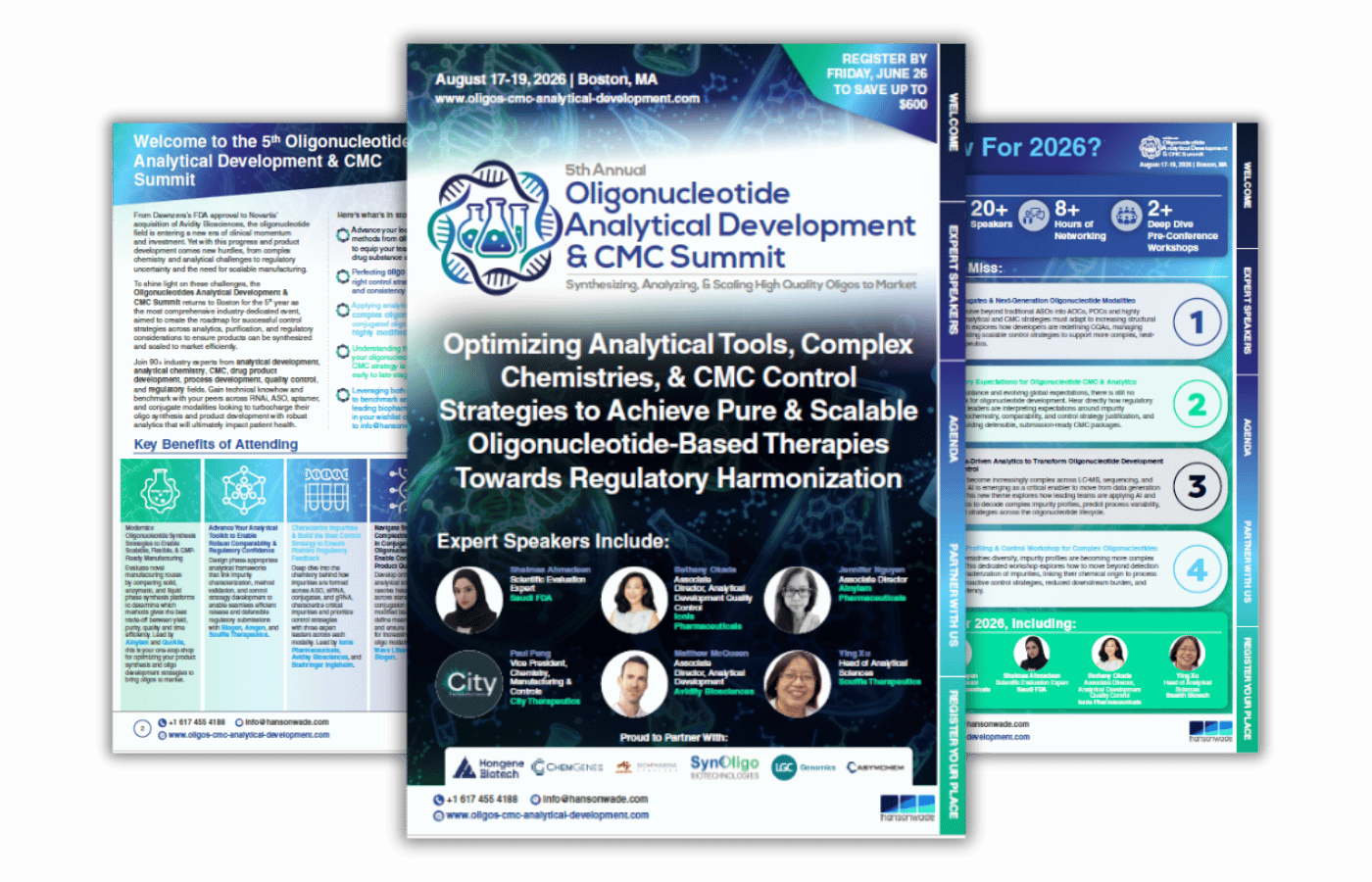
Download the brochure to view the complete agenda, speaker faculty, and a deeper dive into each solution-focused session.

Need Help Identifying the Most Relevant Sessions for Your Pipeline?
Contact the team to discuss your current bottlenecks and get tailored recommendations on where you’ll gain the most value.